Showing posts with label how to brew. Show all posts

Monday, April 2, 2007

Carboy and bottling update

Sorry it's taken me 8012 years to get this uploaded, but here goes our carboy (secondary fermentation vessel) and bottling days extravaganza!

March 24, 2007 - Enter the carboy
So, this is actually quite simple. Get a good siphon going from the primary and let her rip! Just make sure that the carboy is nice and clean and sanitized!
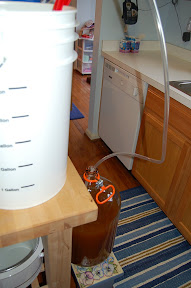
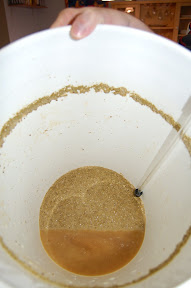
Mmmm, yeasty goodness
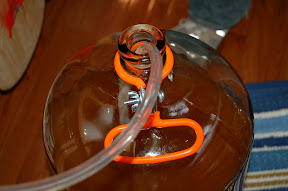

I wrapped the carboy in some beach towels to keep it at as constant a temperature as I could, and to block out any light, slapped my bung and airlock on it and let it sit for a week. (UV radiation, is what actually produces the "skunk" in beer. So, a nice crystal clear carboy would allow all of that through.)


April 1, 2007 - I'm no fool when it comes to bottlin' my life away
This too is pretty easy. Overnight I had cleaned and sanitized two cases of 12 oz bottles to make my life pain-free. Until I dropped an empty bottle, neck first, on my foot. Joy.

Moving on, one must carefully transfer the beer from the carboy to the bottling bucket - might I suggest a siphon, again? This time, I broke part of my racking cane connecting the tubing to it. Still usable though. Joy.
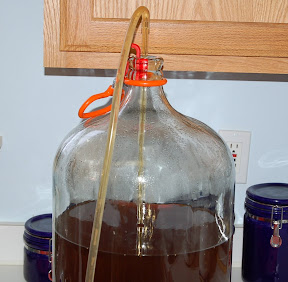
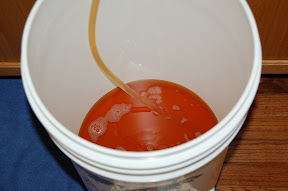

Moving on, I boiled 2 cups of water and 5 oz of corn sugar to act as a primer for the left over yeast in the beer. This will allow the yeast to feed and to carbonate the beer once bottled. Pour that in the mix in the bottling bucket full of beer, attach the bottling wand to some more tubing, connect that to the bottling bucket and let her go! Weee!
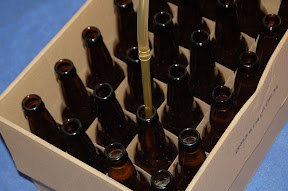

Capping is actually a pretty fun thing to do, with two people you can roll through two cases in about 10 minutes.

I figure a week or two for conditioning and we'll see what we have. Maybe a rite of Spring fest will be in order...

Monday, February 5, 2007

TAKE THE POLL!

Please vote for what should come next out of my mad, mad laboratory...err, kitchen. I have 48 empty bottles yearning for some beer! (It's on the right, in blue.)

I'll close the poll on Thursday, March 1st. And brew the winning beer March 3rd! (I'll shop for the fresh goodies that Friday.)

Oh yeah, I'll get you pics of the complete process as I wreck my kitchen!

Remember, be responsible drinkers! And from Kaiser Wilhelm, "Give me a woman who loves beer and I will conquer the world."

EVERY VOTE COUNTS

Monday, January 22, 2007

Howtobrew.com

HowToBrew.com by John Palmer has a great crash course in how to brew. The course goes over brewing with malt extract, extract and grain, and brewing with all-grain. Each section is then split into chapters that include; hops, fermenting, bottling, how mash works, and more. This is a wonderful website with lots of good information. It is worth going through page by page.

They have a great section on common problems you find when you're brewing. http://www.howtobrew.com/section4/chapter21-1.html

Here is one example from the website:

Symptom: The fermentation seems to have stopped but the hydrometer says 1.025.

Cause 1:
Too Cool This situation is commonly referred to as a "stuck fermentation" and can have a couple causes. The simplest cause and probably the most common is temperature. As previously discussed, a significant drop in temperature can cause the yeast to go dormant and settle to the bottom. Cure: Moving the fermentor to a warmer room and swirling the fermentor to stir up the yeast and get them back into suspension will often fix the problem.

Cause 2:
Yeast The other most common cause is weak yeast. Referring back to previous discussions of yeast preparation, weak yeast or low volumes of healthy yeast will often not be up to the task of fermenting a high gravity wort. This problem is most common with higher gravity beers, OGs greater than 1.048.Cure: Add more yeast.

Cause 3:
Low Attenuating Extracts Another common cause for extract kit brewers is the use of extracts high in dextrins. Two brands are known to be high in unfermentables, Laaglanders Dry Malt Extract (Netherlands) and John Bull Liquid Malt Extract (UK). These are not bad extracts, in fact they are high quality, but their use is better suited to heavier bodied beers like strong ales, porters and stouts, where a high finishing gravity is desired.

Friday, January 5, 2007

Some links

Here are two links that I thought might be useful:
http://realbeer.com/jjpalmer/Howtobrew.html/ and
http://www.prochiller.com/.

The first link is for brewing a small first batch at home. Early on, I found it to be tremendously useful in regard to the terminology. The second link is for some industrial-strength cooling when you eventually decide to open your own brewery/brewpub. The products here will cool your wort in a jiffy.